A little festive television
The holiday television special is an art form distinct from the feature film. Built for small glowing screens on frosty evenings, these concise narratives hold an intimacy that cinema rarely captures.
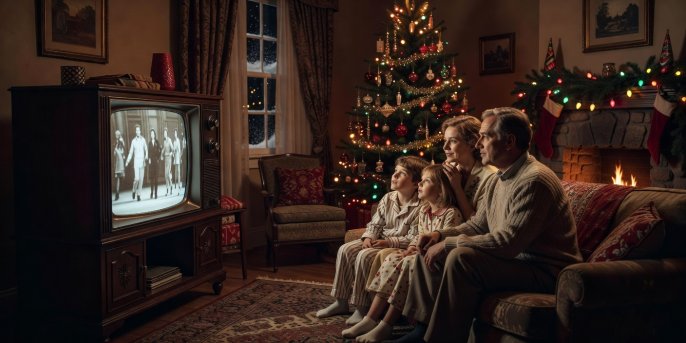
Before on-demand streaming flattened television into an endless scroll of interchangeable icons, the holiday special was a nationwide event. Families consulted the printed television listings weeks in advance, circling broadcast times with ink pens. That temporal scarcity created an extraordinary focus. When millions of households turned their dials to the same broadcast channel at 8:00 PM on a Tuesday in December, a communal warmth united disparate neighborhoods.
Yet beyond nostalgic ceremony, the half-hour television format enforced a remarkable narrative economy. Television writers could not indulge in redundant subplots or bloated exposition. They had approximately twenty-four minutes of actual screen time to establish character, evoke the frosty reality of winter, introduce a moral or spiritual dilemma, and resolve it with heartfelt resonance.
The Golden Age of Stop-Motion: Rankin/Bass Productions
Between 1964 and 1985, the production team of Arthur Rankin Jr. and Jules Bass established an aesthetic shorthand for winter enchantment. Utilizing their proprietary “Animagic” technique—meticulously animated armatures filmed frame-by-frame by master animators in Tokyo studios like MOM Productions—Rankin/Bass created a tangible, tactile universe of felt snow, wooden reindeer, and glass-eyed wanderers.
Consider 1964’s Rudolph the Red-Nosed Reindeer. While modern audiences recall its cheerful songs, the story remains fundamentally about systemic ostracism. Hermey the Elf refuses to make toys because he longs to be a dentist; Rudolph is banished from athletic games because his luminescence is deemed defective; the Island of Misfit Toys is populated by abandoned figures mourning their perceived imperfections. The resolution does not come from conforming to authoritarian standards, but from the community realizing that vulnerability and uniqueness are essential for survival when blizzards strike. This emotional substance explains why felt puppets from sixty years ago still move modern children to empathy.
The Melancholy Jazz of Charles M. Schulz
When CBS executives previewed A Charlie Brown Christmas in December 1965, they predicted disaster. The production lacked a laugh track; it employed real non-actor children to voice the Peanuts gang; it concluded with Linus reciting the Gospel of Luke under a single spotlight; and it was scored not by brassy holiday orchestral arrangements, but by the quiet, contemplative acoustic piano of Vince Guaraldi.
The network was wrong. Broadcast to roughly 45% of all television sets in the United States on December 9, 1965, the special captured an authentic emotional truth: for many people, the holiday season evokes profound loneliness and commercial exhaustion. Charlie Brown’s struggle with depression and his defense of an impoverished little fir tree resonated because it validated viewers’ private ambivalence toward commercialized celebrations. That subtle, jazz-infused honesty remains unmatched in animated broadcasting.
How the Grinch Stole Christmas! (1966)
Directed by animation legend Chuck Jones and narrated by Boris Karloff, this 26-minute adaptation of Dr. Seuss remains a masterwork of kinetic timing. Jones gave the Grinch an expressive, serpentine physical comedy while preserving Seuss’s rhyming verse intact.
Key virtue: The triumph of communal song over physical possessions when the Whos sing without a single ribbon or tag.
The Snowman (1982)
Commissioned by Britain’s newly founded Channel 4, this wordless masterpiece transformed Raymond Briggs’ picture book into moving art. Rendered entirely in colored pencil without dialogue, it embraces the bittersweet truth that beauty is temporary and snow must melt.
Key virtue: The walking in the air flight sequence and its poignant, quiet final shot.
British Seasonal Broadcasting: Ghost Stories and Hearthside Wit
While American television developed cartoon specials, the British broadcast tradition evolved around distinct domestic rituals: the BBC A Ghost Story for Christmas series initiated in December 1971 by Lawrence Gordon Clark, and the legendary seasonal comedy specials of Morecambe and Wise.
Adapting the chilling ghost stories of M.R. James, the BBC understood that the winter solstice is historically a time of shadow. Broadcasting tales of haunted cathedral stalls, ominous railway signals, and ancient cursed whistles at 11:00 PM on Christmas Eve tapped into an ancient human instinct: drawing closer to the fire while the icy gale rattles the windowpanes. These small-scale television productions relied on sound design, atmospheric landscapes, and subtle psychological dread rather than gruesome spectacle, offering an intellectual counterpoint to daytime merriment.
How to Incorporate Television Specials into Modern Evenings
Today, when entire seasons of television can be binged without pause, reclaiming the deliberate pacing of the 30-minute special can rejuvenate your holiday season. We recommend treating a special not as background noise, but as a deliberate prelude. Turn off room lights, mute phones, gather hot drinks, and allow the focused, compact magic of mid-century broadcast art to re-anchor your household in the season.